Music in the News: “Musicians Hear Better”

Say What?! Musicians Hear Better

(Here’s the link to this NPR article: http://www.npr.org/templates/story/story.php?storyId=113938566&sc=nl&cc=cn-20091020) by Jon Hamilton
 listenarchived_sm

October 19, 2009 – Musical training can improve your hearing, according to several studies presented in Chicago at Neuroscience 2009, the annual meeting of the Society for Neuroscience.

The studies found that serious musicians are better than other people at perceiving and remembering sounds. But it’s not because they have better ears.

Sounds come in through the ears. But they travel through the nervous system and get interpreted by the brain.

That means your hearing can change even if your ears don’t, says Nina Kraus, who directs the Auditory Neuroscience Laboratory at Northwestern University.

“Your hearing system becomes tuned by the experiences that you have had with sound throughout your life,” Kraus says.

The Musician’s Brain

Kraus figured that the hearing systems of musicians ought to be more finely tuned than those of other people. So she tested their ability to do something challenging: understand what someone is saying in a noisy room.

Fifteen classically trained musicians and 16 nonmusicians listened to a voice reciting simple sentences against an increasingly loud backdrop of other conversations.

Standard hearing tests had shown that the musicians’ ears weren’t any more sensitive than those of the other listeners. But Kraus knew that their brains, shaped by years of training, had become very good at a similar task:

“A musician will be listening to the sound of his own instrument even though many other instruments are playing,” she says, a skill not unlike separating one voice from a crowd of voices.

Kraus wanted to know whether this skill helps musicians pick out a particular voice the same way they pick out a particular instrument. “And resoundingly it does,” she says.

A closer look at musical brains may explain why.

Tests show that certain sounds produce stronger electrical signals in a musician’s brain stem, Kraus says. And, she says, these signals offer a more accurate representation of pitch, timing and tone quality — three things that help us pick out a single voice in a noisy room.

Music May Help Children Learn Language

Another study presented at Neuroscience 2009 suggests that musical training could help children who are struggling with language.

“These kids seem to be impaired in the very areas that musicians excel,” says Dana Strait, a doctoral candidate in Kraus’ lab who has studied the oboe and piano for many years.

Strait asked musicians and nonmusicians to take a simple test.

“They were asked to click a button every time they heard a specific sound,” she says, “but not click a button to other sounds that they might hear.”

Musicians not only responded faster and more accurately; they were able to stay focused longer, Strait says.

In contrast, many children with dyslexia and other language problems do poorly on tests like this. Musical training could offer a way to improve their performance, Strait says.

“Musical experience can change how our brain interacts with sounds,” she says. “It’s almost like the brain is better able to pay attention to sound and [to] better extract meaning from sound.”

Training Lasts Despite Hearing Loss

A third study by scientists from Friedrich Schiller University in Jena, Germany, found that musicians could detect harmonies that were slightly off-key even when they had lost most of their hearing. Factory workers with similar hearing loss could not.

Results like these make sense if you think about the brain and the hearing system as if they were muscles, says Dr. Mark Jude Tramo, a professor of neurology at Harvard and director of the Institute for Music & Brain Science.

Tennis players tend to be good arm wrestlers because they have strong forearms, Tramo says. In much the same way, he says, a musician who exercises certain parts of the brain “is going to be able to do better on any task that involves auditory concentration.”
Dianne Donovan Interviews Kathryn Mishell

If you missed KMFA’s show Classical Austin last Sunday evening, here’s your chance to hear the interview…. KMFA host Dianne Donovan interviewed Kathryn Mishell, Artistic Director of Salon Concerts. They chatted about the upcoming concerts on Sunday and Monday (Oct. 18 & 19)  as well as highlights of the upcoming season (it’s their 20th Season!).

Here’s the link:  http://www.kmfa.org/MishellInterview.htm.  Enjoy!

~Alison Cowden, KMFA webmaster

My First Firebird

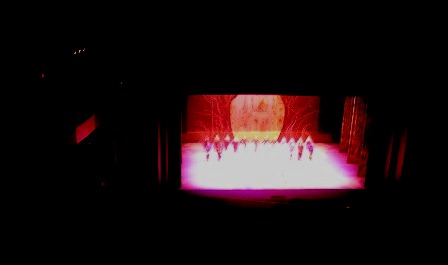
Ballet Season Opener 016The atmosphere at the Long Center on Sunday of the Ballet Austin’s season opener was calm and serene, probably a stark contrast to the people down the road at Zilker Park braving the mud at ACL Fest. 

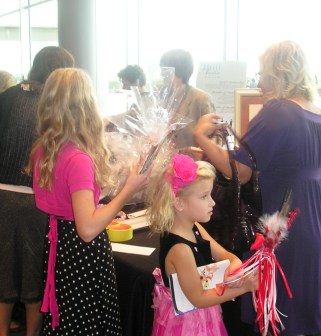
The make up of crowd was surprising. There were dozens of small children, especially little girls dressed up in tutus, carrying feather fans and signed pointe shoes bought at the colorful swag tables.

The performance started with the second act of Swan Lake. It was traditionally staged and performed, beautiful as it always is.

Ballet Season Opener 010


I however was more interested in seeing the Firebird. It was my first time seeing the Firebird actually performed as a ballet, and being a BIG Stravinsky fan I was excited. I was so thrilled with the performance, it was truly worthy of it’s composer. The choreography, stage effects and costumes were colorful and moody which perfectly reflected the complex and sometimes quirky nature of Stravinsky and his music. The costumes were fantastic and had a wide range of styles from the traditional red tutu of the Firebird to Kastchei the Immortal looking like he just left the set of The Nightmare Before Christmas.

 Ballet Season Opener 012

Ballet Season Opener 015

Artistic Director Stephen Mills answers audience questions

Afterward, choreographer Steven Mills held a question-and-answer session with the audience. He spoke briefly about the history of the Ballets Russes and the history of the Swan Lake and Firebird, then opened the floor to questions. It was an absolutley delightful afternoon and I can’t wait for Ballet Austin’s next production!

~Sarah Addison, Membership Associate

The Dynamic Duo is Aptly Named

ONE DYNAMIC DUO – Bates Rectal Hall October 7th, 2009-Butler School of Music –  University of Texas-Austin

Bion Tsang (cellist) and Anton Nel (pianist)

Anton Nel and Bion Tsang

Whether it was the gorgeous chordal surprises of Barber, the playful and percussive folk melodies of  Prokofiev or the lyrical sounds of Grieg, this dynamic duo executed this challenging program with ease and artistry.  Tsang and Nel had a communication that seemed mostly telepathic.

When the audience, on their feet, refused to leave Bates Recital Hall, it was rewarded with a couple of crowd-pleasers as encores — “The Swan” by Saint-Saens, and a Hungarian Dance by Brahms.

It is always a treat to hear two such superlative artists perform together.


~ Dianne Donovan, KMFA anouncer, host, and producer of Classical Austin, airing Sundays at 7pm.


Sonata, Op. 6, for Cello and Piano by Samuel Barber

Sonata in C, op. 119,  for Cello and Piano by Sergei Prokofiev

Sonata in A minor, Op. 36, for Cello an Piano By Edvard Grieg

Baroque Bliss at St. Austin’s

GalleryOrgan

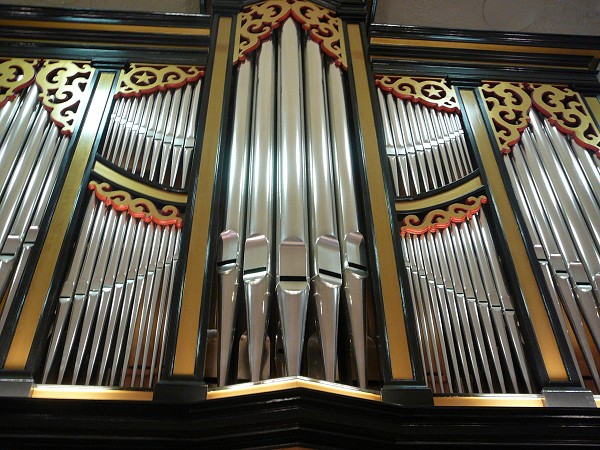
This is the gallery organ at St. Austin's Church on Guadalupe St.


There are many great things about living in America. But, if you’re an organ nut like me, one of the distinct disadvantages is the lack of authentic Baroque organs. Yes, I miss having a Schnitger down the street!  But the organ at St. Austin’s Catholic Church, recently built in the 18th century South German tradition, warmed my organ-loving heart at a Monday-evening performance by Eric Mellenbruch, organist of the Episcopal Church of the Good Shepherd; he gave a wonderful recital of mostly Baroque works, pieces that really showed what this little organ can do!

We were welcomed by St. Austin’s Music Director, Dr. John J. Hoffman. He invited us to walk around the sanctuary during the concert to hear the organ from various vantage points. Ordinarily I would have loved this, but I opted to remain in my seat to spare my fellow listeners the sound of my clickety-clackety shoes!

Mr. Mellenbruch dove straight into the good stuff with a rollicking Praeludium by Dieterich Buxtehude. (If you’ve never heard that word used to describe organ music before, please, do yourself a favor and listen to a good recording of Buxtehude!) We were also treated to a worshipful and serene ciacona based on a hymn tune by Johann Gottfried Walther, a set of variations by Sweelinck that really showed off the colors of the organ, and a glorious Fantasia by the little-known Belgian composer Abraham van den Kerckhoven. The solo voice used in that piece, the Sesquialtera, was the aural equivalent of a cool, clear cascade of water.

If you get the chance, go hear this instrument! The little organ that can (and does!) open the door for us to travel back to the Baroque — a pleasant journey indeed in the hands of an organist like Eric Mellenbruch.

~Sara Hessel, KMFA  Music Director

What a GREAT Day!

summer_songIt’s our last day of the Fall Pledge Drive, and we are mere dollars away from our goal as I write this… and everyone is excited and buzzing about, even more than usual!
Announcers are humming as they play music and chat between breaks; my fellow staff members are singing a few bars as they dash back and forth from the pledge room to the Master Control booth; volunteers are excitedly taking calls and sharing the fun as they talk on the phone; and everywhere, someone will spontaneously burst into laughter.

It’s my favorite day of the drive, and while we are always thrilled to achieve this goal, I’m a little bit sorry to see it end. The flurry of activity, the calls and comments of listeners, the fast-paced interaction with colleagues and volunteers…. as well as the insights, observations, and humor that our beloved on-air announcers share with us as they ask us to step up and pledge… these are some of my favorite things about the Pledge Drive.

Before we are swept up in the final wave of pitching and pledging and applause, I just want to thank all our listeners and donors for keeping Austin classical!

Thanks again,

~Alison Cowden, office manager

A Poem for our Pledge Drive

Hi, I’m Kelsey Padgett, a UT student who has had the good fortune to be a long-time intern here at KMFA.

As you may know, our Fall membership drive is coming up fast, and we are excitedly preparing. I get to help open listener correspondences, including letters of joy and encouragement from devoted listeners.

Recently we received a beautiful poem about the classical music we air on KMFA, 89.5, and I asked if I could share it on our blog:

The Sounds of KMFA

From out of

The past,

Sounds of today.

Sounds for

Your day

And mine.

Sounds to

Work to,

Sounds to

Play to,

Sounds to

Relax to.

Sounds of

Giants

Coming across

The years,

Coming Through

The atmosphere,

Coming to

Calm, enlighten

And inspire.

Sounds of Genius

Talking in

Musical notes,

Through metal,

String, and reeds.

Sounds of conversations

Among instruments,

Teasing, Taunting,

Luring us

From our depths

To their heights,

Sharing their

Gift

With humanity.

Sounds of

Classic beauty

Traveling

Sophisticated equipment

To modern ears,

Sounds uniting

Past and present

In a timeless

Union.

Author: Viola Rutz

Thanks so much Mrs. Rutz, and everyone who gives their support during our membership drive.

~ Kelsey Padgett, Production & Development Associate

Piano Enthusiasts — Watch “Note by Note” on KLRU!

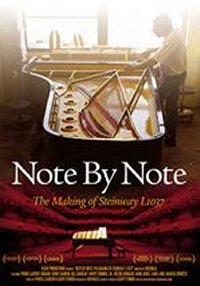
I noticed a great show airing tonight on KLRU (our local Public Broadcasting Station)… Note by Note: The Making of Steinway L1037. Note_by_Note-_The_Making_of_Steinway_L1037

Here’s the official synopsis:
NOTE BY NOTE (THE MAKING OF STEINWAY L1037)
“The most thoroughly handcrafted musical instruments in the world, Steinway pianos are as unique and full of personality as the world-class musicians who play them. However, their makers are a dying breed: skilled cabinetmakers, gifted tuners, experienced wood workers and hand-crafters. This program follows the creation of a Steinway concert grand, #L1037 — from the Alaska forest to the concert hall. It explores the relationship between musician and instrument, chronicles the manufacturing process and illustrates what makes each piano unique in this age of mass production. The journey spans 12 months, 12,000 parts, 450 craftsmen and countless hours of fine-tuned labor. ”

That sounds a little dry… compared to the viewer comments left on the movie’s offical website:

“Our family viewed Note by Note this weekend… none of us spoke for the entire 81 minutes… beautifully filmed and told. None among us is a pianist, yet this documentary touched us deeply. Bravo!”

The film has won numerous Film Festival awards. It should be well worth the watching!

~ Alison 🙂

In the KMFA Studios: La Follia!


Soprano Gitanjali Mathur

Soprano Gitanjali Mathur

LFsmall15

Harpsichordist (and artistic director) Keith Womer

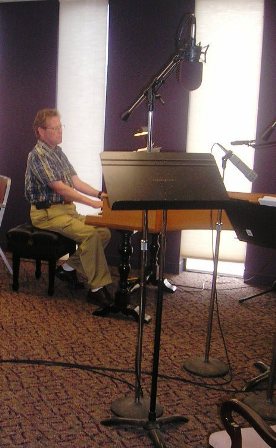
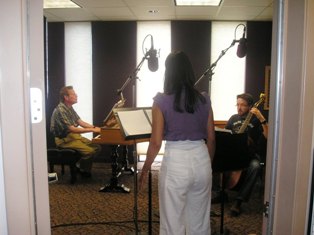
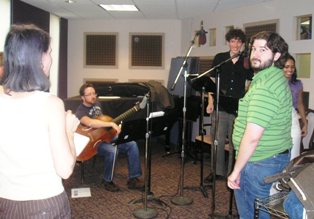
Inter-studio newsflash: La Follia Austin Baroque is here in the KMFA studio as I type this! They are preparing for a live/recorded-to-tape interview with Dianne Donovan for her Sunday evening show, Classical Austin. It’s causing quite an exciting buzz on what is usually a quiet Friday afternoon here at KMFA… I’ve been walking around our first-floor offices, exclaiming “Did you know there’s a *harpsichord* in Studio 2000?!”

Here are few photos I took while they were warming up….they sound wonderful, and there’s a concert on Monday with guest performer, Andrew Hallock, at the First Presbyterian Church, at 8pm. I don’t think it’s on their website, so you heard it here first! 😉

~Alison Cowden, KMFA Blogger

LFsmall1

Keith Womer tunes the harpsichord while James Brown warms up the viola da gamba


LFsmall4

Jeffrey Blair scrutinizes the microphone placement


 LFsmall5


LFsmall7

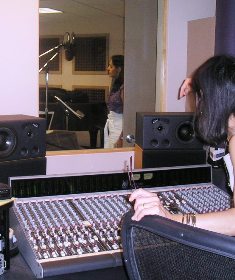
Dianne checks levels on the board during warm-up


LFsmall10

Dianne (left) and Phil (right) do a sound check

LFsmall9

Countertenor Andrew Hallock


For more information about this early-music group, including their upcoming concert schedule, visit their website: www.LaFollia.org.

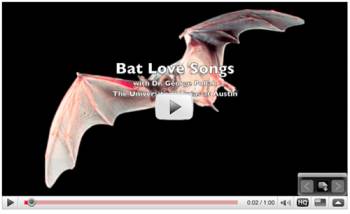
Love Songs of Bats… Decoded


a bat named "Sid" pitches woo

a bat named "Sid" pitches woo


(This article is posted in its entirety on the U.T. website: click here.)

AUSTIN, Texas — It might not sound like crooners singing about love on the radio, but bats sing love songs to each other too, say researchers at The University of Texas at Austin and Texas A&M University who are believed to be the first to decode the mysterious sounds made by the winged creatures.They determined that male bats sing songs with distinguishable syllables and phrases to attract females, and in some cases, to warn other males to stay away.

“I am amazed at the richness of the vocal repertoire that bats use for social communication,” says George Pollak. “Their courtship songs are perhaps the most surprising, since each song is complex and structured.”

“The sounds they make are very difficult for the human ear to pick up,” explains Kirsten Bohn, the lead researcher of the project. “It’s at a very high frequency range, but our recording equipment could track it very well.

“The sounds are made in a specific, arranged pattern to form a song, and there are actually organized sequences within each phrase. They are made to attract and lure in nearby females.”

The researchers recorded bats from Austin, where more than one million Mexican free-tailed bats live downtown beneath Ann Richards Bridge, and Kyle Field in College Station, where an estimated 100,000 to 250,000 bats are believed to be winging their way around the football stadium and athletic complex.

“We compared the recordings made by bats in Austin to those at Kyle Field, and we discovered they were almost exactly the same,” says Bohn. “The bats in both places use the same ‘words’ in their love phrases.”

Bohn says the results are surprising because in general terms, mammals such as bats don’t have language rules—the use of specific sequence of phrases and a complex means of communication to others in their species.

“With the possible exception of whales, you normally don’t have this type of communication technique,” she says. “You see it frequently in birds, but that’s about it. We’ve learned the vocal production of bats is very specific and patterned, and now we have a model not only to study communication similarities in other animals, but also human speech. So we think this is a big first step.”

Pollak adds, “Who would have thought that bats could have one of the most sophisticated and rich vocal repertoires for communications of all animals?”