TCC gives us our our “Choir Fix” for the season

(photos by R. Sweeney)

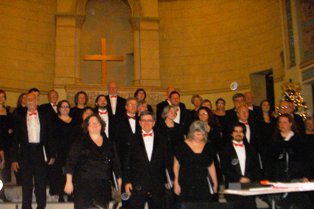
Last weekend we enjoyed our Christmas choir “fix” for the season: several of us attended the Texas Choral Consort annual Christmas event,  this year titled: Winter on the Wing.   

KMFA’s daytime announcer, Dianne Donovan, introduced the event on Friday evening, and our very own Phil Pollack (Technical Operations Manager) was one of the performing tenors. There were lots of familiar faces in the crowd (I went to the Sunday performance) and I recognized several friends and members of KMFA.  

As usual, there was a diverse sampling of musical treats, ranging from an early-music German piece by Buxtehude, to a contemporary piece by jazz musician Vince Guaraldi. The Director, Brent Baldwin, even participated in an early Spanish piece, “Riu, Riu, Chiu”… sample some short videos below… fun!).  

For a choral layman like me, it’s always entertaining to enjoy the relatively obscure alongside the comfortably familiar.  🙂  

~ submitted by Alison @ KMFA  🙂


Three Questions for Lauren Rico, KMFA Program Director

[posted by Kelsey Padgett, KMFA Development-Production Associate]

What’s the difference between Program Director and Music Director? Who does what at my favorite classical station? We sat down with Program Director Lauren Rico to learn a bit about the behind-the-scenes roles at KMFA. 

Lauren Rico

Lauren Rico, KMFA Program Director, co-hosting a live opera broadcast

KP: Could you describe the position of Programming Director and what you do for KMFA? 

LR: “The Program Director monitors the station’s sound from day to day. How does each host sound on each shift? How do all the weekend programs work together? Are people hearing the perfect program during the perfect time of day?

“The Program Director is responsible for the overall sound of the station. At KMFA, I manage duties ranging from coaching our hosts to deciding what shows air when. I write some of the promotional materials you hear on the station, and starting in January will host a new program called Reverie.

“My biggest duty, though, is to the listeners of KMFA. I must always have them in my mind. With every decision I make, I ask myself, “Will this benefit our listeners?” I’m constantly striving to find interesting and fun ways to engage our audience, both on air and in the community.” 

KP: How is your position different from Sara Hessel’s, KMFA’s Music Director? 

LR: “While I’m responsible for the overall sound of KMFA, Sara Hessel, Music Director, is more responsible for the sound of KMFA from hour to hour. I entrust to Sara the creation of each individual hour of music you hear on the station. She determines which CDs qualify for the library, what pieces are played during which parts of the day, and what kind of special programming is put into place for various holidays and special events. Sara’s vast musicological knowledge and her passion for classical music make her a natural as Music Director. In other words, she makes my job a whole lot easier!” 

KP: What is your favorite classical piece? 

LR: “There are so many to choose from! I LOVE all things Bach and Copland. But my favorite piece? I’d have to say it’s a tie between Morten Lauridsen’s “Dirait-on” and Franz Biebl’s “Ave Maria.” At my wedding a few years back, I arranged for the whole ceremony to come to a complete halt so an a capella ensemble could sing them for me. It’s good to be the bride!”

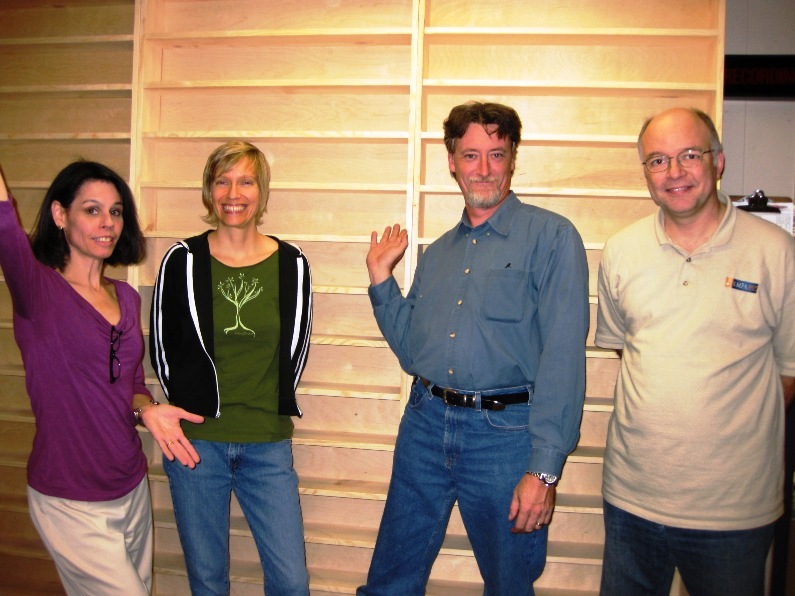
In the KMFA Studios — NEW CD shelves!

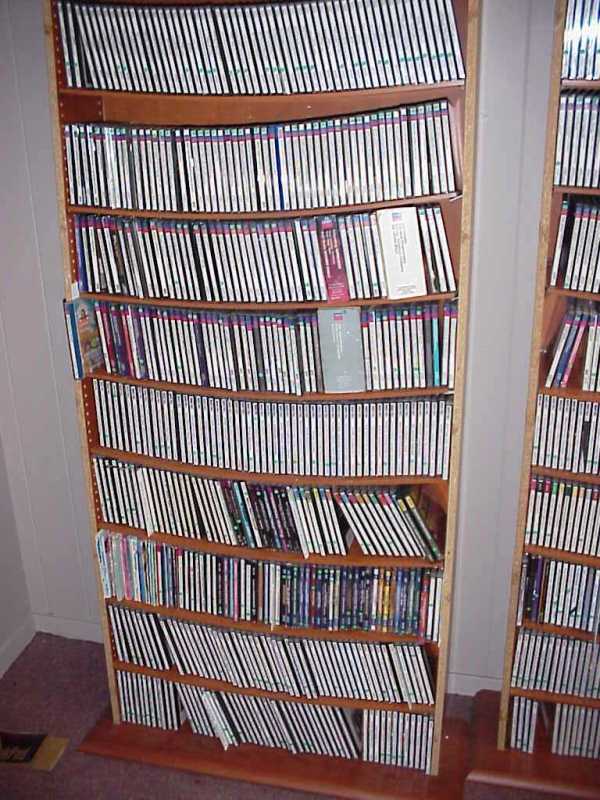
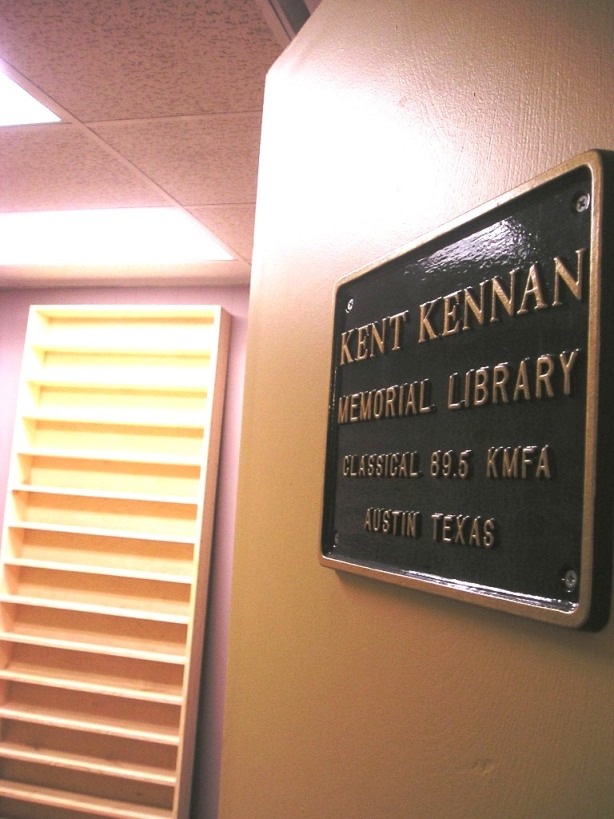
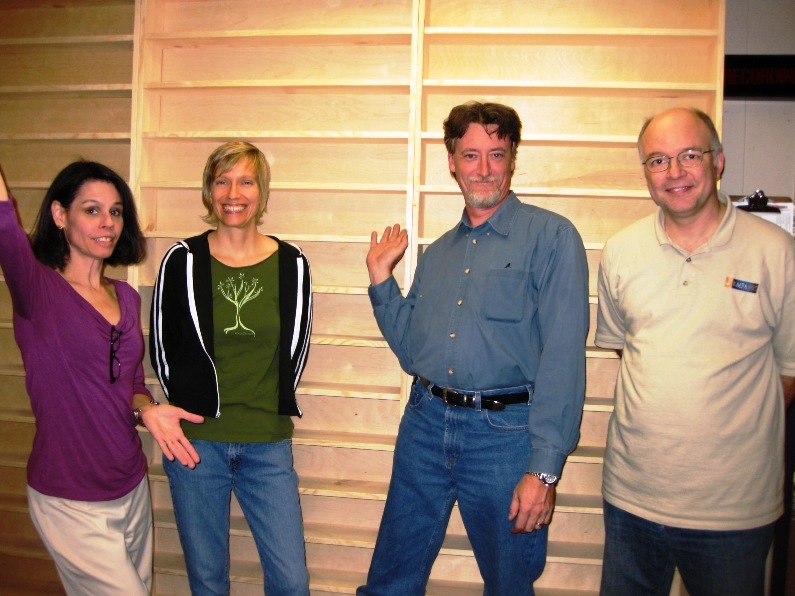
Well, Christmas came early at KMFA this year: we finally got new CD shelves for our Kent Kennan Memorial Library!

We’re pretty excited, because our old shelves were approaching collapse, and just plain looked bad… and thanks to the generosity of our members during the last membership drive, we were able to raise funding specifically designated for replacing our shelves.

Here’s a photo of one of our “old” CD shelves: 


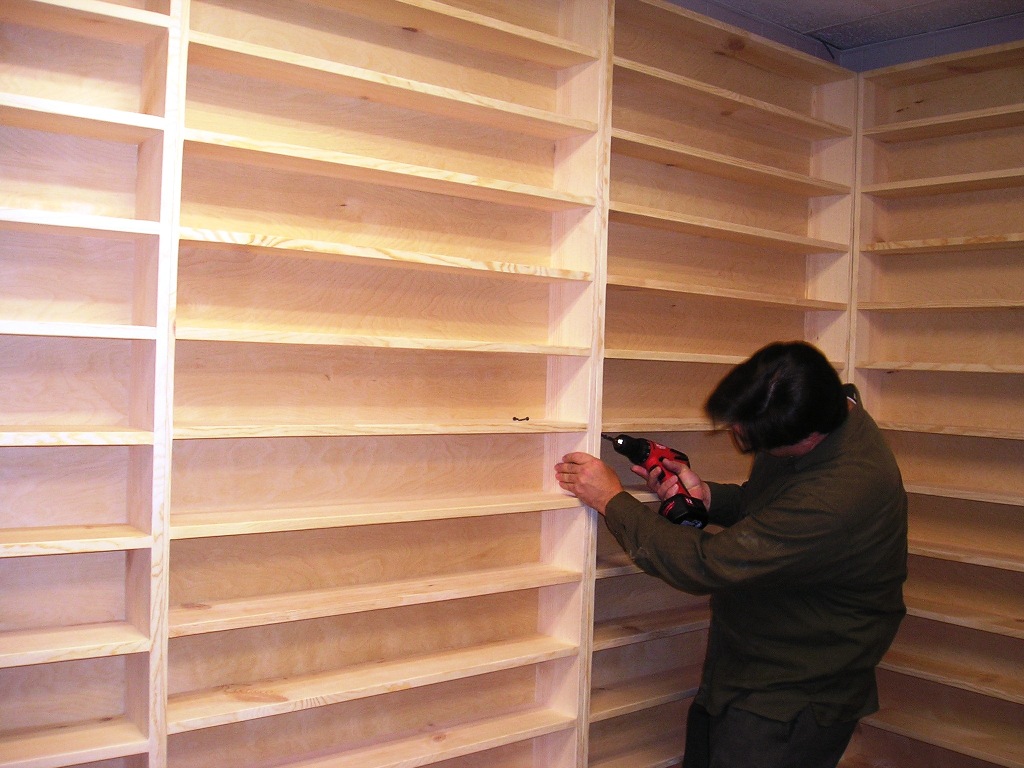
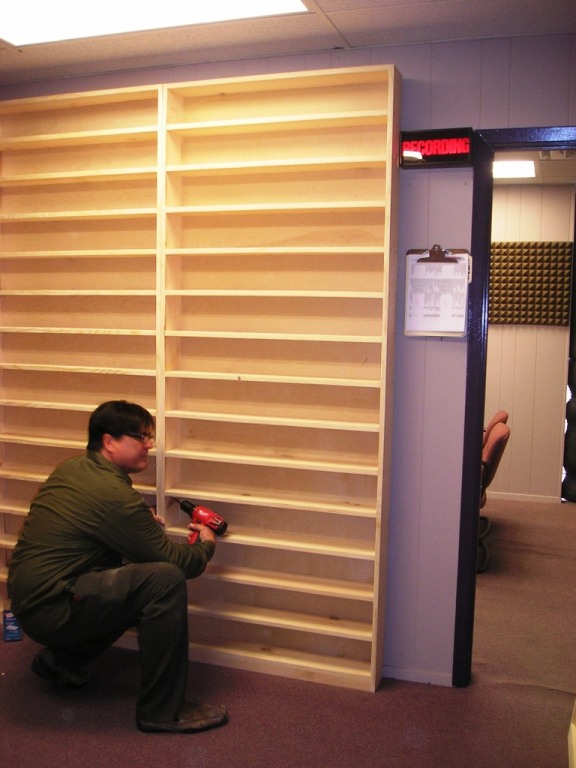
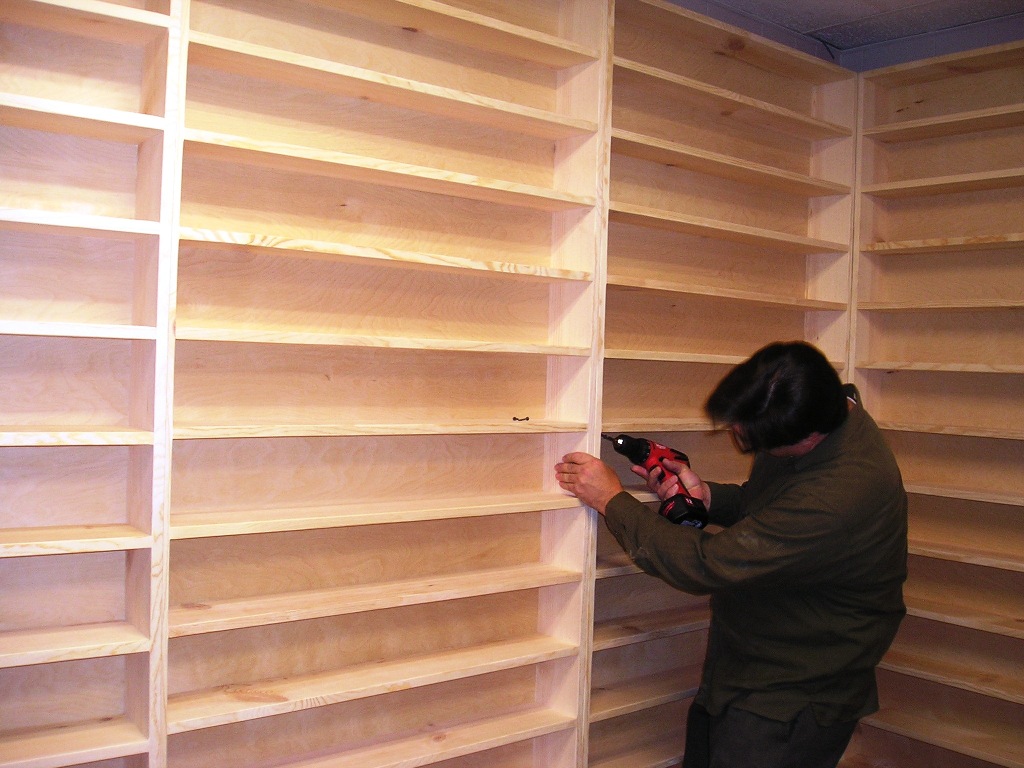
…and here are some photos of our great new shelves!


John Mitchell of the Bookcase Store secures the shelf to the wall


We KMFA announcers are so happy to have new shelves! 🙂


 Special thanks to John Mitchell at the Bookcase Store. He did a great job!  🙂


The Biotech Stradivarius

“The 50 Best Inventions for 2009” is TIME Magazine’s picks for the best new gadgets and breakthrough ideas of the year. On that list:  The Biotech Stradivarius!
 
Here’s the blurb about it from their website (link: http://snipurl.com/tbyd4)
On Sept. 1, an audience of experts took part in a blind test of five violins. One of the violins was a $2 million Stradivarius, made in 1711 by the greatest stringed-instrument maker of all time. Another was a modern violin made of wood that had been specially treated by Professor Francis Schwarze of the Swiss Federal Laboratory for Materials Testing and Research. Schwarze used two fungi to alter Norwegian spruce and sycamore to closely resemble the wood Stradivarius used, then commissioned a violin maker to build an instrument with them. The listeners were asked to identify the Strad, and 113 picked Schwarze’s violin. The actual Stradivarius got only 39 votes. One theory has it that Stradivarius’ violins sound better because the craftsman lived in a brief climatic period that produced particularly high-quality wood.

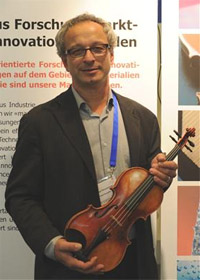
Swiss vio­lin maker Mi­chael Rhon­heim­er with one of his “bio­tech” vio­lins. ~ photo, EMPA

Austin Symphonic Band… is in the opera?!

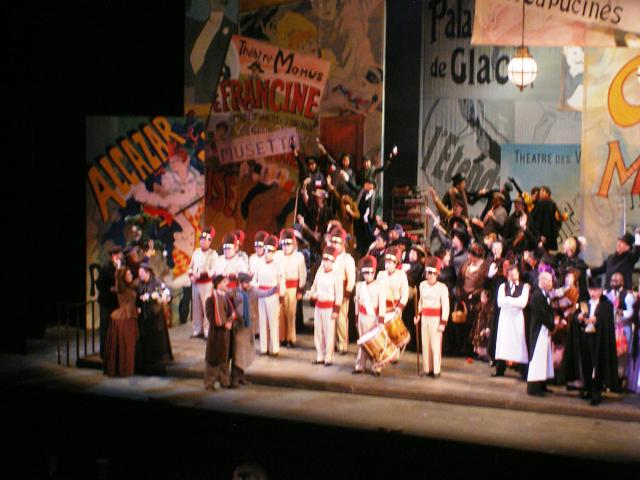
If  you were one of the lucky folks to attend the ALO’s season premier, La Boheme,  you enjoyed more than fine arias and a beautiful stage… I just found out that some members of the Austin Symphonic Band were in the production as well!

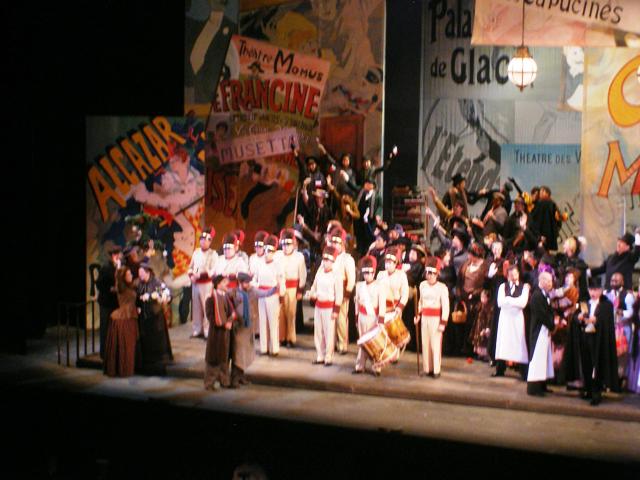
David Jones, one of the participants (and a great friend of KMFA), sent us the link to their behind-the-scenes photos.   The wind players comprised the off-stage/on-stage La Banda, marching through the set at the end of Act II.

Here’s one of the photos:

The Tableau

If you are at all acquainted with the ASB, you know that these folks are fun-loving wind enthusiasts with a great sense of humor. Just when I was beginning to think that opera productions were full of intense and serious professionals…. someone starts playing a trumpet and my preconceived notions are dashed!  🙂


~Alison  🙂

At the Opera: ALO’s La Boheme!

 (submitted by Doug Shands, producer of KMFA’s Windsounds)
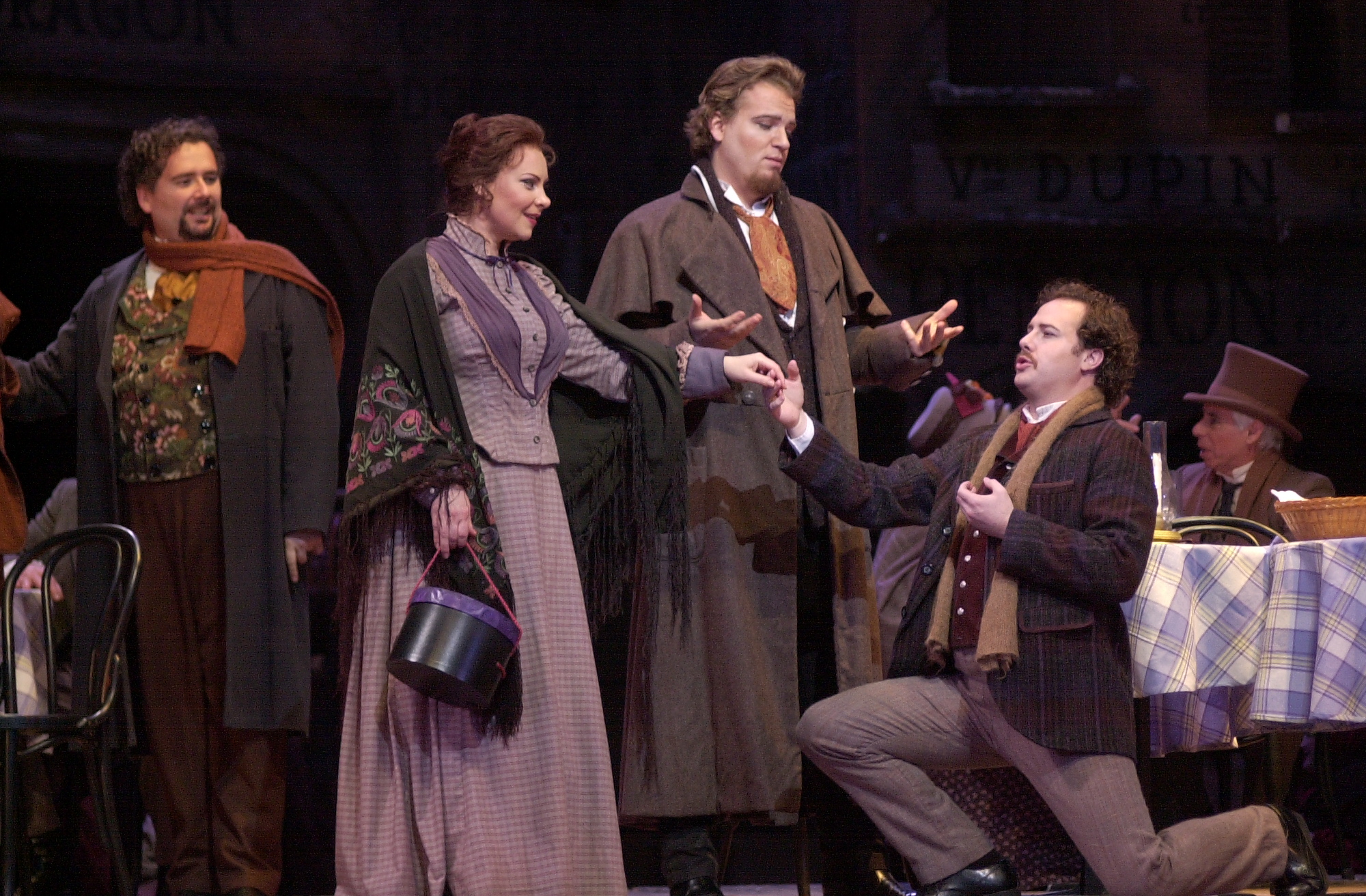
My friend Bruce and I attended the Friday performance of Austin Lyric Opera’s production of Puccini’s La Boheme. The performance was excellent, and the staging was perfect for the story! The singers portrayed their respective roles in a believable and appropriate manner.


La Boheme is an opera wonderfully suited for a neophyte’s first opera. The Austin cast was humorous when called for and sad when necessary. Mimi’s death scene at the conclusion was touching, without being maudlin. The sets were great! They gave the feel of 19th century Paris and in some cases were truly works of art. In my opinion, La Boheme set a high standard for future Austin Lyric Opera productions!

~ Doug Shands

The Bach Cantata Project at the Blanton Museum


(posted by Cara Kannen, KMFA’s Membership Director)

 “I’m BACH!”  😉

Let me first take the opportunity to express how overjoyed I am to be back at KMFA. Besides the wonderful people here, and non-stop immersion in beautiful music, one of the things I missed most during my time away from the station was attending the Bach Cantata Project performances at the Blanton.

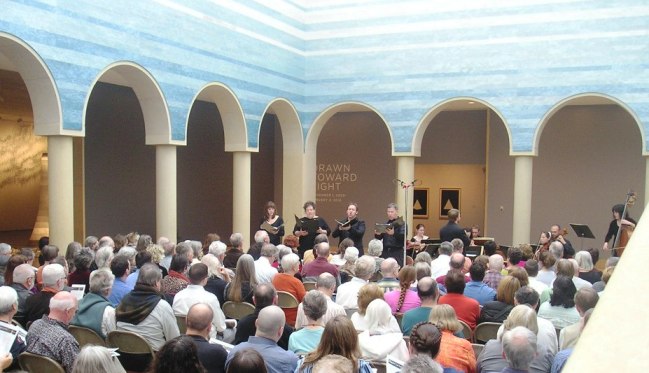
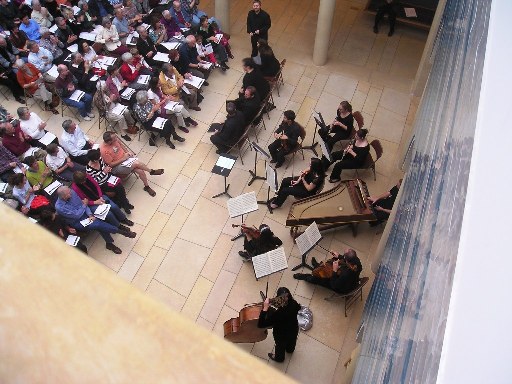
For those who have never been, the Bach Cantata Project is a joint venture between the choral department of the UT Butler School of Music and the Blanton Museum of Art. Each month, students and faculty present a beautiful Bach cantata in the Blanton’s atrium. Afterward, a Blanton tour guide hosts a special viewing and history of a featured piece of artwork chosen to tie closely to the theme of the cantata.

The first time I heard a Bach Cantata performed in the atrium, I marveled at how surprisingly pleasing the acoustics were and how beautifully the space, with its soaring ceiling and skylights, set a tone of peaceful contemplation. Another relatively recent enhancement in the atrium, installed around the first of the year, is a site-specific work in cast acrylic titled Stacked Waters. The reflective striped-blue patterns around the atrium walls resemble water and lend an additional element of peacefulness to the venue.

The theme of October’s cantata was based on a communion hymn, composed by Bach for performance in 1724. Whether thoughts of observing communion or celebrating God’s wedding feast filled your mind, the warmth of the music certainly fed the soul at the noon hour.

I encourage you to mark your calendar for the next Bach Cantata Project on Tuesday, November 24th. Museum admission covers both the music performance and the galleries and tours after. The performance begins at noon and is the perfect escape over the lunch hour for a refreshing change. But do plan to go a little early, as the seats fill up fast. Bach Cantata project performances take place the last Tuesday of every month (except December) from September through April. Maybe I will see you there….I’m the one in the “standing room only” section dancing next to the KMFA banner!

Cheers!

~ Cara

Music in the News: “Musicians Hear Better”

Say What?! Musicians Hear Better

(Here’s the link to this NPR article: http://www.npr.org/templates/story/story.php?storyId=113938566&sc=nl&cc=cn-20091020) by Jon Hamilton
 listenarchived_sm

October 19, 2009 – Musical training can improve your hearing, according to several studies presented in Chicago at Neuroscience 2009, the annual meeting of the Society for Neuroscience.

The studies found that serious musicians are better than other people at perceiving and remembering sounds. But it’s not because they have better ears.

Sounds come in through the ears. But they travel through the nervous system and get interpreted by the brain.

That means your hearing can change even if your ears don’t, says Nina Kraus, who directs the Auditory Neuroscience Laboratory at Northwestern University.

“Your hearing system becomes tuned by the experiences that you have had with sound throughout your life,” Kraus says.

The Musician’s Brain

Kraus figured that the hearing systems of musicians ought to be more finely tuned than those of other people. So she tested their ability to do something challenging: understand what someone is saying in a noisy room.

Fifteen classically trained musicians and 16 nonmusicians listened to a voice reciting simple sentences against an increasingly loud backdrop of other conversations.

Standard hearing tests had shown that the musicians’ ears weren’t any more sensitive than those of the other listeners. But Kraus knew that their brains, shaped by years of training, had become very good at a similar task:

“A musician will be listening to the sound of his own instrument even though many other instruments are playing,” she says, a skill not unlike separating one voice from a crowd of voices.

Kraus wanted to know whether this skill helps musicians pick out a particular voice the same way they pick out a particular instrument. “And resoundingly it does,” she says.

A closer look at musical brains may explain why.

Tests show that certain sounds produce stronger electrical signals in a musician’s brain stem, Kraus says. And, she says, these signals offer a more accurate representation of pitch, timing and tone quality — three things that help us pick out a single voice in a noisy room.

Music May Help Children Learn Language

Another study presented at Neuroscience 2009 suggests that musical training could help children who are struggling with language.

“These kids seem to be impaired in the very areas that musicians excel,” says Dana Strait, a doctoral candidate in Kraus’ lab who has studied the oboe and piano for many years.

Strait asked musicians and nonmusicians to take a simple test.

“They were asked to click a button every time they heard a specific sound,” she says, “but not click a button to other sounds that they might hear.”

Musicians not only responded faster and more accurately; they were able to stay focused longer, Strait says.

In contrast, many children with dyslexia and other language problems do poorly on tests like this. Musical training could offer a way to improve their performance, Strait says.

“Musical experience can change how our brain interacts with sounds,” she says. “It’s almost like the brain is better able to pay attention to sound and [to] better extract meaning from sound.”

Training Lasts Despite Hearing Loss

A third study by scientists from Friedrich Schiller University in Jena, Germany, found that musicians could detect harmonies that were slightly off-key even when they had lost most of their hearing. Factory workers with similar hearing loss could not.

Results like these make sense if you think about the brain and the hearing system as if they were muscles, says Dr. Mark Jude Tramo, a professor of neurology at Harvard and director of the Institute for Music & Brain Science.

Tennis players tend to be good arm wrestlers because they have strong forearms, Tramo says. In much the same way, he says, a musician who exercises certain parts of the brain “is going to be able to do better on any task that involves auditory concentration.”

Dianne Donovan Interviews Kathryn Mishell

If you missed KMFA’s show Classical Austin last Sunday evening, here’s your chance to hear the interview…. KMFA host Dianne Donovan interviewed Kathryn Mishell, Artistic Director of Salon Concerts. They chatted about the upcoming concerts on Sunday and Monday (Oct. 18 & 19)  as well as highlights of the upcoming season (it’s their 20th Season!).

Here’s the link:  http://www.kmfa.org/MishellInterview.htm.  Enjoy!

~Alison Cowden, KMFA webmaster

A Familiar Voice in an Unexpected Venue…

baldwin_bio_banner

On Tuesday evening I was listening to KMFA’s regular weekly program,  New York Philharmonic This Week. Well, not so much listening as passively enjoying the performance music in the background while I worked on some documents… and as the pieces were introduced, I kept wondering, where have I heard that voice before….?

The Radio Host of New York Philharmonic This Week is Alec Baldwin!  As a Long Island native, Mr. Baldwin has been a big fan of the NY Phil, so it all came together quite naturally, it seems. He does a wonderful job, although I’ll admit I keep expecting him to say some absurd and hilarious remark like his comedic character from his television show.

Read more about it on the NYPhil website: http://nyphil.org/about/bio_baldwin.cfm

~Alison Cowden, KMFA webmaster