Bion Tsang and Anton Nel featured on KLRU-TV

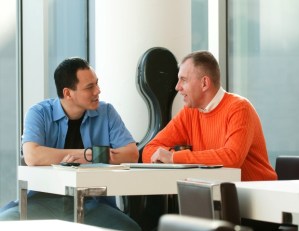
Remember that KLRU taping that a lot of us went to in February, featuring virtuosos Bion Tsang and Anton Nel? Well, the show will appear tonight (August 26th) on the Austin PBS show, In Context.

Here’s more information:

AUSTIN, TEXAS – Cellist Bion Tsang and pianist Anton Nel make their PBS broadcast debut as cello/piano collaborators on Thursday, August 26, at 8 p.m. on KLRU-TV, Austin PBS. The half-hour IN CONTEXT special was recorded in February 2010 in KLRU Studio 6A, home of the venerable live music series Austin City Limits. KLRU’s IN CONTEXT art series presents performances from some of Austin’s leading artists and cultural organizations.

(The half-hour TV special features cello/piano works from Boccherini, Rachmaninov, Shostakovich, Beethoven and Brahms.)

KMFA announcer Jules Brandon blogged about it at the time (her first blog entry, I think!) and by all accounts the performance was stellar. Austin is so lucky to have these two musicians in our very own city. We highly recommend watching this performance!

~posted by Alison @ KMFA 🙂

It’s Leonard Bernstein’s birthday

Today is Leonard Bernstein’s birthday! Of course we’ve been featuring his works all day today on KMFA.

Most folks remember Leonard Bernstein’s credits in all things musical, from ballet, opera, and musicals, to orchestral, chamber, and piano pieces. He was truly an artist belonging  to America’s Golden Age of popular culture. But he was also a renowned educator; in particular, consider his Young People’s Concerts….

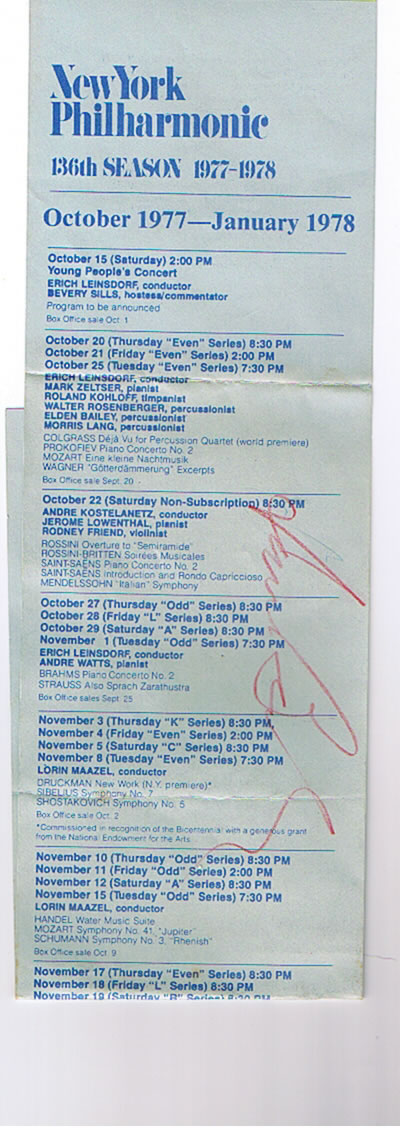
I was recently talking to friend of mine who grew up in New Jersey, and we were talking about how, as kids, we would do things on a dare that we would never have the courage to do otherwise. And, quite randomly, she described how she attended a concert in NYC with her elementary school class, and her classmates dared her to ask for the conductor’s autograph — so she marched right up to the podium and asked Leonard Bernstein for his signature on the program! She said he looked startled, but willingly signed it. He was just guest-hosting at that point, so it was a rare appearance. And she still saved it after all these years, although she was basically unaware of his stature in the classical music canon. (See the image at left.)

Here’s a quote from his son, from the official Leonard Bernstein website:

In 1957 Bernstein had convinced CBS to put his Young People’s Concerts on the air. To think that for a while there, Leonard Bernstein’s Young People’s Concerts with the New York Philharmonic were on CBS primetime television!! All over America, families gathered in their living rooms in front of their big, bulky black & white TV sets, and watched Leonard Bernstein tell them all about classical music. I can’t tell you how many people come up to me now, everywhere I go in the States, and they say something like: “Oh, I used to watch your father’s Young People’s Concerts on TV, and I’ve been a music lover ever since!” And an equally large number of orchestra musicians come up to me and say, “I watched the Young People’s Concerts when I was a kid, and that’s why I’m a musician today!”

Bernstein’s great gift was his ability to convey his own excitement about music. Watching him explain sonata form or the difference between a tonic and a dominant, you had the sense that he was letting you in on a wonderful secret, rather than drumming facts into you that might prove useful later. It doesn’t matter what your subject is; a teacher’s own passion is going to improve the student’s ability to absorb and process the information. Excitement is contagious.

Here’s a partial video of one of his earlier Young People’s Concerts, about the origins of Folk Music. I love how he compares language dialect to musical dialect:


Well, here’s to you, Maestro Bernstein. Your birthday is really an opportunity to reflect on all you have done for classical music in your lifetime, and ours!

~posted by Alison @ KMFA 🙂

Metamorphoses: from Ovid to Britten

~posted by Renee Beale, KMFA part-time announcer

I recently watched the performance of Metamorphoses at Zachary Scott Theatre and absolutely enjoyed the performance.  I am always so pleased to find Austin’s cultural community willing to take risks.
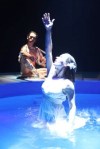

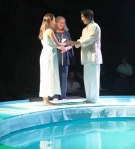
Metamorphoses is a presentational play based on the poem written by the Roman poet Ovid .  This modern adaptation, written by Mary Zimmerman, is a unique presentation with a very simple set that revolves around a pool. Vignettes from Ovid’s poem are told utilizing this pool in interesting ways… for example, the play itself allows for modern costuming, such as the bathing suits worn by the young and beautiful female narrators of King Midas, mixed with the classic Grecian togas such as worn in the vignette about Alcyone and Ceyx.  (I thoroughly enjoyed seeing the nouveau riche King Midas appearing on stage in full western regalia of the modern day rancher.  It  brought regional humor with which the audience connected.)

Ovid inspired composer Benjamin Britten to write a solo piece for Oboe based on six of the mythological characters in Metamorphoses, and of course inspired playwright Mary Zimmerman to create her version of Metamorphoses being performed now for Austin audiences to enjoy.  To that I say: enjoy, marvel at the antiquity of the poem, and how fortunate we are that this great work has survived through time.

~posted by Renee Beale, KMFA part-time announcer
(photos courtesy of Zach Scott Theatre)

Summer greetings from Carmel O’Donovan

~posted by Carmel O’Donovan, KMFA part-time announcer

It has been a long summer and I have been away from Austin for far too long!

I have badly missed the dulcet tones of my fellow announcers, as well as the glorious music mix on KMFA, as I have explored Arizona, California, Nevada and New Mexico on a big road trip with my family reminiscent of the Griswolds. (Where is Chevy Chase when I need him?)

Try as I might (and believe me, I tried hard — I find that using classical music to drown out fighting siblings works a treat), I could not find a radio station to hold a candle to our dearly beloved KMFA. All of which reinforced something that we all know: we have our own little treasure right here in Central Texas — the jewel of the airwaves at 89.5 and the guarantee of glorious classical music 24/7. What could be better for the soul and the spirit?


~ Carmel O’Donovan is a part-time announcer on KMFA 89.5; you can read more about Carmel and all our Music Hosts on our website.

See Brian Satterwhite at the Alamo Drafthouse

Are you a fan of KMFA’s weekly show, Film Score Focus? Have you always wanted to put a face to the voice of host/producer, Brian Satterwhite?

Well, this Sunday you can see him in person at the downtown Alamo Drafthouse! He’ll be introducing the screening of Alfred Hitchcock’s North by Northwest, with special attention paid to the score composed by Bernard Herrmann. The Alamo website says, “Before the show, Brian will discuss the score, its history, construction and inspiration. You will truly come to understand how the pieces of film music fit together and how a score is constructed to convey drama, action and character. Then, when we watch the film, we can experience it not just as a film made by a master but as a great work of music as well.”

For more information about tickets and location, visit the Alamo Drafthouse website.

~posted by Alison @ KMFA 🙂

Having fun with Art in the Park at Symphony Square

~posted by Angelica Davila, KMFA programming intern

The Austin Symphony Orchestra’s Children’s Day Art Park is, quite simply, awesome. Held every Wednesday morning from June to July, the Art Park invites children and parents to enjoy some wholesome summer fun with music, arts and crafts, magicians, mimes and more. And for only 50 cents a kid, I think it’s much more than a bargain.

This past Wednesday—unfortunately the last session of the summer series—hundreds of kids piled into Symphony Square on Red River, ready for the fun to begin. Despite a few over-hanging rain clouds, the day started in the Square’s amphitheatre with some clowning around, a little magic, and a family-friendly performance by The Biscuit Brothers.

During these performances, a few colorful volunteers set up shop underneath a large red-and-white tent across the street. Markers, paint, balloons and chairs waited as The Brothers finished their set and the crowd moved from the theatre. The main event under the tent is face painting, but there are also coloring tables and arts and crafts areas, as well as a lemonade stand for just 10 cents a cup. And while you and your children are waiting in line (for that’s really the main event), you can enjoy a live brass band playing on a nearby porch or interact with one of the many clowns roaming through crowd. You can even get a photograph with that morning’s headliner—and I’m no sap, but seeing The Biscuit Brothers high-five a shy little 6-year-old is just adorable.

For the parents, the second half of the day could be a bit of a bummer—I mean, Mom and Dad aren’t waiting in a line for 20 minutes to get their face painted. But the whole park just radiates fun and energy because the kids are having the times of their lives. Even last week, when it was hot, humid and more than a little rainy, every child in the crowd was smiling and laughing. And though the festivities might be over for now, mark your calendars for next summer because the Art Park is fun, cheap and well worth the time.


~posted by Angelica Davila, KMFA summer Programming Intern (she also took all these great photos!)

Jeffrey Blair asks: Are conductors really necessary?

~posted by Jeffrey Blair, KMFA morning announcer

I recently came across this article in the LA Times, pondering the need for conductors in today’s symphonies:  http://articles.latimes.com/2010/aug/15/entertainment/la-ca-what-conductors-do-20100815

It’s funny that this question seems to come up every couple of years or so;  heck, I even asked the same thing when I was knee-high to an armadillo. I remember I was just a young radio geek in training and I thought it must be pretty cool to be the conductor. Standing up on this little podium with your back to the audience (it must be tempting to make faces at the orchestra and try to get them to crack up), waving around this little stick, telling the orchestra what to do with the slightest crook of your little finger. And then after the performance you get to acknowledge all the applause. Yep, that’s the life for me.

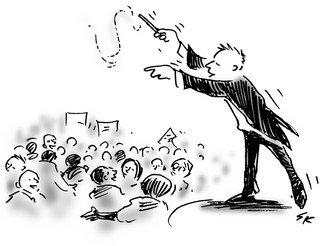
 Then I started recording orchestras and going to rehearsals other than the final dress. I quickly found out that conducting is HARD WORK. The part about standing up in front and waving the baton around is actually the end of a long and grueling process that is just as demanding if not more demanding than giving a solo recital. It’s been said that violinists play the violin and pianists play the piano, but conductors play the orchestra. From what I’ve picked up from various conductors, this is absolutely true. Conductors tell the various segments of the orchestra when to get loud, when to get quiet, when to come in, when to play vigorously, and when to play with great emotion. It all has to match what they think the composer wanted, what the audience expects, and what his or her interpretation happens to be. That’s a lot of plates to keep spinning at the same time.

 The L.A. Times article spells it out much better than I can, with conversations with Leonard Slatkin, Vladimir Ashkenazy, Sir Colin Davis, and others, but they all agree that a conductor brings his own interpretation to a score. Sometimes it’s good…sometimes it’s not so good, but its the conductor’s job to figure out phrasing, emotional direction and balance. Then they have to convey all of that to the musicians in such a fashion that they can bring about the desired reaction from the audience. Imagine someone translating Beowulf from Old English and then telling someone else who then tells you, but you still expect to get the full emotional impact from the original story. It’s a tough job and I’ll leave it to the professionals!

 I still want to stand with my back to the audience and wave the baton around. That part would be fun. 🙂

 
Jeffrey Blair is KMFA’s weekday morning announcer, Production Engineer, and host of the weekend show,
 Choral Classics. Tune in Sundays at 10am and 5pm to hear Choral Classics, right here on KMFA, 89.5

A Farewell to Mitch Miller

~ posted by Rich Upton, KMFA Operations Manager and afternoon announcer


Mitch Miller died Saturday, July 31.  He was 99.

The younger you are, the less likely you are to know who Mitch Miller was.  I was born in 1955, and much of the earliest music I remember hearing came to my ears courtesy of Mitch Miller.

He was a musician, a singer, a record producer, a choral director, a conductor, a television personality, a record company executive, and an Artists and Repertoire man for a major record label.  His career encompassed popular music, easy listening, classical, film music, and country music.  He abhorred rock music to the point that he passed up the opportunity to sign Elvis Presley (whose manager wanted too much money for Miller’s taste) and Buddy Holly (although he himself DID eventually record an embarrassing version of John Lennon’s “Give Peace A Chance”).  He produced records for Frank Sinatra, Tony Bennett, Marty Robbins, Rosemary Clooney, Johnny Mathis, Guy Mitchell and many others, and while many of these records were hits, Miller had plenty of critics who felt that he reduced these singers to the lowest common denominator by aiming for the charts (often with novelty songs) rather than making great records.

I remember becoming aware of Mitch Miller in the early ’60s when “Sing Along with Mitch” appeared on the NBC television network.  Each week, Miller smiled non-stop while conducting a male chorus in well-known songs, inviting the audience at home to “follow the bouncing ball” that moved along the top of superimposed lyrics, and sing along.  That’s his male chorus you hear singing Paul Anka’s “Theme from ‘The Longest Day'” under the credits for that film.

Miller was a classically trained oboist, and guest-conducted many fine American orchestras.  He appears as a conductor in the KMFA music library on a 1987 recording with pianist David Golub and the London Symphony Orchestra of George Gershwin’s works for piano and orchestra.


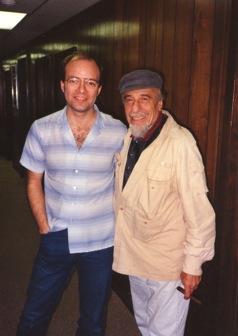
This photo of Mitch Miller and me was taken in the hallway at the KMFA studios in 1995.  I was 40 then, and Miller was a spry 84.  (As you can see, this was also before we painted the dark brown paneling on the walls, and, as evidenced by the cigar in Miller’s hand, before smoking was disallowed in the building.)  He came by the studios for an interview. I don’t know if it ever aired, and the fate of the recording is unknown to me.  But it was a privilege to meet such a legend, and he was a very nice man.  The smiles on our faces are genuine.

Thanks for all the music, Mitch.  You will be missed.

Rich Upton is KMFA’s weekday afternoon announcer, KMFA Operations Manager, and host of Sunday Night Symphony. You can hear Sunday Night Symphony on Sundays at 9pm.