The Austin Polish Film Festival – A Cultural Revelation

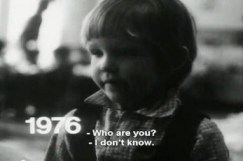
Born in 1976

Who are you; what would you like; what do you think is important?

~posted by Hannah Schaeffer, KMFA administrative assistant

I am as new to KMFA as I am to Austin. I have only lived in the outskirts for the past few years, so I am just now able to truly explore and discover this diverse and wonderful city. Naturally, I was excited to be sent to the Austin Polish Film Festival for my first blogging assignment. I did not know about the Austin Polish Society before the festival, so this event was the perfect opportunity for learning more about their community and Austin as a whole.

The festival spanned over the course of 5 days, and I attended the final day of the festival on Saturday, November 12th at the Marchesa Hall and Theatre. I enjoyed five short films and one full-length feature, including a live interview with one of the headline actors from the final film. I was moved by a beautiful, yet tragic animation about the man who invented moving pictures in color, and entranced by a modern story of love and intrigue in the age of computer/reality simulation.

My favorite feature was a quick documentary from the year 1980 called “Talking Heads” in which Polish citizens were asked three questions: “Who are you, what would you like, and what is important to you?” The film began with charming and hopeful responses from young Polish children. As the interviewees slowly grew older, their hopes, dreams and identities grew more diverse. Words like “choice, work and freedom” transitioned into “democracy, health, suffering and humanity” as a montage of older professionals from academics to miners discussed their hopes for the future on the black-and-white screen. Finally, a 100 year-old woman playfully confessed that she just “wants to live longer.” I was delighted to have learned so much about a foreign society in such a small amount of time.

Needless to say, I was grateful to have experienced this cultural and artistic celebration. The APS has so much to offer Austin, so I hope to see more from them in the near future.

~Hannah Schaeffer 🙂
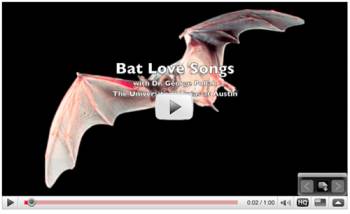
Love Songs of Bats… Decoded


a bat named "Sid" pitches woo

a bat named "Sid" pitches woo


(This article is posted in its entirety on the U.T. website: click here.)

AUSTIN, Texas — It might not sound like crooners singing about love on the radio, but bats sing love songs to each other too, say researchers at The University of Texas at Austin and Texas A&M University who are believed to be the first to decode the mysterious sounds made by the winged creatures.They determined that male bats sing songs with distinguishable syllables and phrases to attract females, and in some cases, to warn other males to stay away.

“I am amazed at the richness of the vocal repertoire that bats use for social communication,” says George Pollak. “Their courtship songs are perhaps the most surprising, since each song is complex and structured.”

“The sounds they make are very difficult for the human ear to pick up,” explains Kirsten Bohn, the lead researcher of the project. “It’s at a very high frequency range, but our recording equipment could track it very well.

“The sounds are made in a specific, arranged pattern to form a song, and there are actually organized sequences within each phrase. They are made to attract and lure in nearby females.”

The researchers recorded bats from Austin, where more than one million Mexican free-tailed bats live downtown beneath Ann Richards Bridge, and Kyle Field in College Station, where an estimated 100,000 to 250,000 bats are believed to be winging their way around the football stadium and athletic complex.

“We compared the recordings made by bats in Austin to those at Kyle Field, and we discovered they were almost exactly the same,” says Bohn. “The bats in both places use the same ‘words’ in their love phrases.”

Bohn says the results are surprising because in general terms, mammals such as bats don’t have language rules—the use of specific sequence of phrases and a complex means of communication to others in their species.

“With the possible exception of whales, you normally don’t have this type of communication technique,” she says. “You see it frequently in birds, but that’s about it. We’ve learned the vocal production of bats is very specific and patterned, and now we have a model not only to study communication similarities in other animals, but also human speech. So we think this is a big first step.”

Pollak adds, “Who would have thought that bats could have one of the most sophisticated and rich vocal repertoires for communications of all animals?”