And the Beat Goes On …

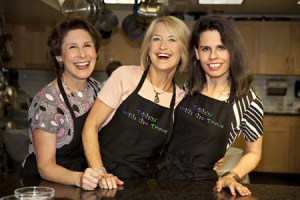
We all know that Dianne Donovan, KMFA’s mid-day announcer, is a classical-music lover. But did you know she sings in a jazz trio?

That’s right, Dianne is one of The Beat Divas. Famous for their singing/cooking classes at Central Market, they recently celebrated a new CD release, called Dishin’ With the Divas: Songs of Food, Love & Mayhem, and they presented several of these songs during the opening ceremonies of the International Association of Culinary Professionals conference. They caught the attention of a New York Times’ writer… and they were featured in yesterday’s edition! You can read the whole article by clicking here.

They were also just featured in the Austin Chronicle, and that article is also on their website.

Here’s their new video for the song “Sweet Treat,” featuring Central Market Chef Robert Jenkins. 🙂

Our KMFA arts partners score big at the 2011 Austin Critics’ Table Awards!

~posted by Sara Hessel, KMFA Music Director

KMFA congratulates our cultural partners who were honored at the 2010-2011 Austin Critics’ Table Awards:

Ballet Austin (Best Ensemble for Kai)

Austin Symphony Orchestra (Best Symphonic Performance for Rodrigo’s Concierto de Aranjuez with Pepe Romero)

Adam Holzman, guitar with the Miro Quartet (Best Chamber Performance for Austin Goes Classical)

Texas Early Music Project (Best Chamber Performance for Convivencia)

Conspirare (Best Choral Performance for Renaissance and Response: Polyphony Then and Now)

Austin Lyric Opera/Austin Chamber Music Center (Best Opera for The Man Who Mistook His Wife For A Hat)

Anne Akiko Meyers, violin (Best Instrumentalist for Anne Akiko Meyers with the Austin Symphony)

Miro Quartet (Special citation: Inimitable FourPlay Award for 15 years with Sandy Yamamoto)

Texas Performing Arts (Special citation: Ears Wide Open Award for adventurous bookings of classical music)

Congratulations, and thank you for all of your efforts in making Austin such a rich artistic environment to live in!

 See the full list of winners here.

Magic vision in Ballet Austin’s “Magic Flute”

Stephen Mills’ Magic Vision

~posted By KMFA mid-day announcer, Dianne Donovan

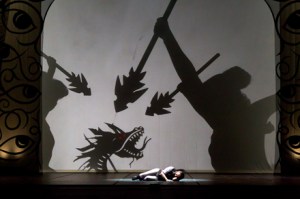
Once again, Austin audiences enjoyed a veritable feast for the eyes (and ears) courtesy of Stephen Mills. In his most ambitious project to date, the Artistic Director and choreographer of Ballet Austin tackled Mozart’s The Magic Flute with nary a singer nor a supertitle in sight. As if setting Mozart’s great opera in a different medium wasn’t enough of a challenge, Mills added something very unusual to the mix; he added shadow puppetry. When I heard about this project, I thought that it could go one of two ways. It went this way — beautifully, that is. The shadows provided scary monsters, thoughtful asides, as well as interesting and almost instant set changes.

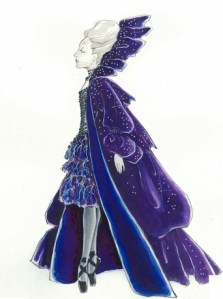
At times the dancers would interact with actual shadow puppets and other times they would team up with shadow dancers from the other side of the screen. ShadowLight Productions of San Francisco created and executed the shadow images. This was more than visual trickery, it was a true integration of forms that enhanced the production. Superimposed over this grey world were some of the loveliest, most colorful costumes I’ve seen on any stage. Costume designer Susan Branch Towne’s exotic birds, when set in motion, were positively kaleidoscopic and the priests’ white uniforms shimmered luminously.

Austin’s Donald Grantham provided a reduced score (sans vocals), well performed by the Austin Symphony Orchestra, under Maestro Peter Bay’s fine direction.

another one of the drawings of the costumes for Magic Flute

Of course mirrors and lights aren’t enough to carry such a production. As I’ve come to expect, Stephen Mills’ inventive and elegantly flowing choreography is sometimes spiked with truly comedic gestures. All of the dancers did a marvelous job of incorporating so many elements into their performance. Ashley Lynn Giffix’s Pamina made me wish that I had nagged my parents a little more forcefully for ballet lessons when I was youngster.

Once again, Stephen Mills “raises the bar” (I couldn’t resist) on what is possible in the world of dance. This production was sooo Austin, soooo Stephen Mills.

If missed the production and would like to see more of the images and costumes, please visit Ballet Austin’s blog.


~posted by Dianne Donovan, KMFA mid-day announcer and host of the show, Classical Austin (Wednesday evenings at 8pm).

Playing Piano…in the Park!

World-famous pianist, Anton Nel, encountered one of the pianos on a hike around Lady Bird Lake

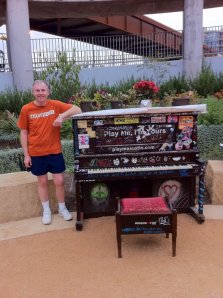
If you’re a fan of the parks and trails around downtown Austin, then you might have noticed random pianos popping up all over… available for anyone to play, at any time of day!

It’s all a part of a delightful conspiracy to provide music where you least expect it, featuring any artist who decides to play. Located throughout downtown in public parks, streets and squares, the pianos are for any member of the public to play. The pianos are also for the public to decorate and personalize.

Well, this is the last weekend to enjoy the pianos, so a few of us from KMFA decided to visit the one in Butler Park. It was such a beautiful day on Thursday!

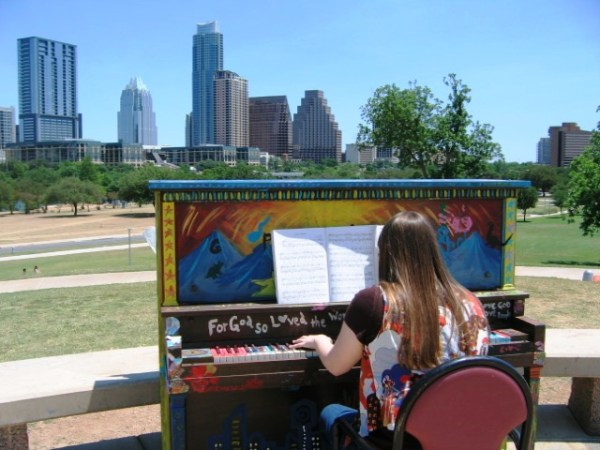
Sarah playing piano in front of the Austin skyline

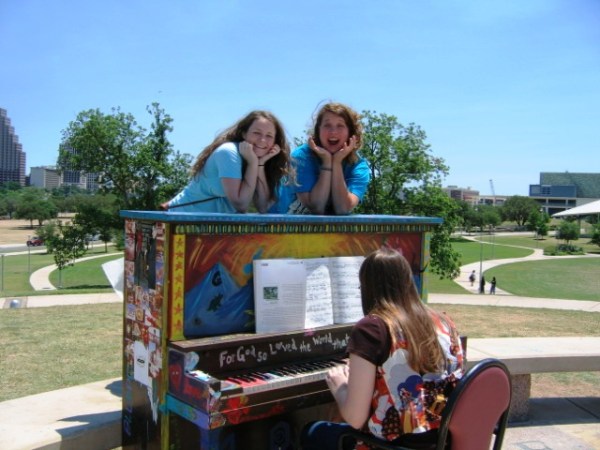
We climbed to the top of Doug Sahm Hill (I think Doug would have been pleased with the psychedelic painted dinosaurs on the side of the piano) and Sarah Addison, who is our resident expert in piano playing, gave her best attempt on this funky, outdoors piano, while we all got to admire the fabulous skyline and listen to a Beethoven backdrop.

Claire and Kelsey wish they'd paid better attention in piano classes when they were kids

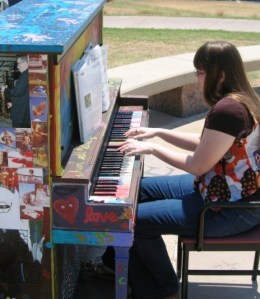
one cheerfully painted piano

You can read more about this effort, as well as see some adorable photos and videos, at the website Play Me I’m Yours.” They also have a map where each of the pianos is located. Go find one this weekend! 🙂 You’ll be surprised how nice a piano sounds outdoors in Austin’s wonderful springtime weather.

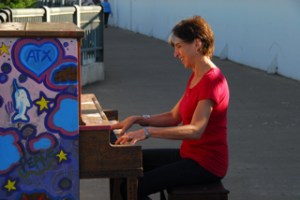
Another favorite Austin piano player, Marcia Ball, tries out a street piano

~ posted by Alison @ KMFA  🙂

Bemused at the Blanton

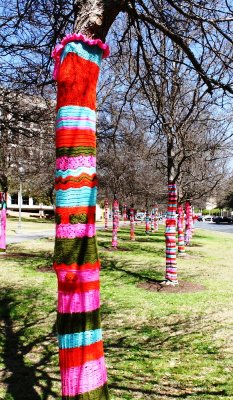
I took advantage of Austin’s pleasant springtime weather to visit the Blanton Museum last weekend… and found a greenbelt of 99 trees covered with knitting, right in front of the entrance!

It was all part of the “Knitted Wonderland” that is officially referred to as a “site-specific installation,” designed by textile artist Magda Sayeg, and crafted by over 170 local volunteer knitters. I confess that when I saw it, I’m old enough to be reminded of toe socks. 😉 The bright knits added vivid color to the yet-leafless trees.

The industriously whimsical tree knits matched the current exhibit going on inside the Blanton: Recovering Beauty. I’ve often encountered literature and art that resulted from societal repression and revolution…. but this exhibit reflects the brief period of freedom from oppression that Argentina experienced during the 1990s.

The exhibited items within are delightful, expressive, metaphorical, and deceptively youthful. Some things appear simply decorative; others tell visual stories, and even provide specific tools for perspective, such as peep-holes on viewing boxes. The imagery and layers of meaning reminded me of literature’s greatest short stories: entertaining and appealing on the surface, rendering deeper content upon greater scrutiny.

I highly recommend visiting the Blanton for this wonderful exhibit. It has been one of my favorites! And the trees will be de-nitted March 25th, so swing by on your lunch hour.  You can find more info on the Blanton website.

~ posted by Alison @ KMFA 🙂

In the KMFA Studios: Matt Haimovitz drops by during SXSW

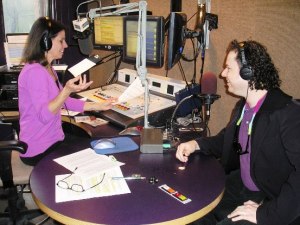
Dianne chats with Matt about classical music and SXSW

Matt Haimovitz: a musical visionary, cellist extraordinaire, and busy performer at SXSW this week, dropped by the KMFA studios today! He chatted on the air with Dianne Donovan about how classical music is not just a niche of music from prior centuries, but a foundation of music for all genres and future composition.

Short bio: From his debut (at age of 13!) as soloist with Zubin Mehta and the Israel Philharmonic, and his first recording for Deutsche Grammophon, Haimovitz is considered a modern cellist virtuoso. In 2000, he made waves with his Bach Listening-Room Tour, wherein Haimovitz took Bach’s beloved cello suites *out* of the concert hall and into clubs across the U.S., Canada, and the U.K.  ….He was the first classical artist to play at New York’s infamous CBGB Club, in a performance filmed by ABC News’ Nightline. He is Professor of Cello at the Schulich School of Music at McGill University in Montreal.

Matt Haimovitz is acclaimed for his visionary approach, groundbreaking collaborations and innovative recording projects. We learned from him today that on March 22nd he will premiere a new cello concerto by Denys Bouliane with the Montreal Symphony and Kent Nagano.

If you missed his on-air interview, you can still listen to it on our website.

~posted by Alison @ KMFA 🙂

Texas Choral Consort offers an oratorio for all seasons

~posted by Dianne Donovan, KMFA mid-day host

Texas Choral Consort’s presentation of Die Jahreszeiten — “The Seasons” — (February 26th & 27th)

If you missed the opportunity to hear Franz Joseph Haydn’s “The Seasons” this past weekend, I’m sorry, really sorry. This masterwork is rarely performed in this part of the world. Although it was written three years after his blockbuster, “The Creation,” it never caught on like its predecessor.
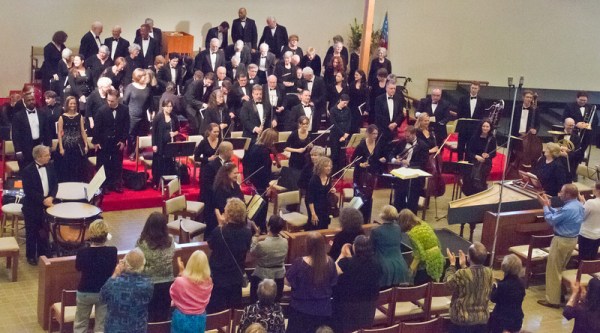
photo credit: Robert Kelly

Much of the neglect rests with what was once an unwieldy English libretto (translated from a German translation/adaptation of an English poem by James Thomson titled, “The Seasons”). Over the centuries, some much-needed changes have improved the original libretto, and for this performance, Artistic Director, Brent Baldwin, deftly selected some of the best texts of the English versions.
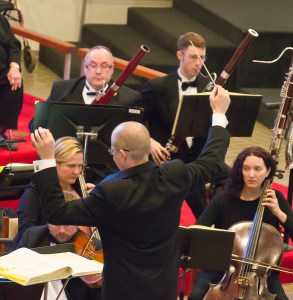
photo credit: Robert Kelly

Having never heard this piece live, I wasn’t sure just how the music would “take flight.” Brent Baldwin led his chorus (the un-auditioned chorus, I might add!) to deliver a very strong and joyous performance. The orchestra was superb tackling this challenging piece and the soloists (soprano, Kirsten Watson as Jenny, baritone, Chaz Nailor as Simon and tenor, Jos Milton as Lucas), sang their arias/ensemble pieces with elegant facility and managed some tricky recitatives with great aplomb.

The other star of course, was Haydn. He was in his element here, with dazzling orchestration and some magnificent tone painting (was that a quail I just heard?). The summer sunrise and the shuddering storm scenes were standouts. As well, he provided inside jokes, as only Haydn could do. With the achingly beautiful opening of “Winter,” it was hard not to think of one W.A. Mozart. Also written into the music were moments of clever interplay between the soloists and chorus, and between the singers and the orchestra.

Cheers to the good folks at Texas Choral Consort for these performances, and to Brent Baldwin in particular for programming and delivering this piece.

Learn more about Texas Choral Consort performances and auditions at www.txconsort.org.

~posted by Dianne Donovan, mid-day host, and producer of Classical Austin

The Sounding Joy: Texas Choral Consort’s Christmas event

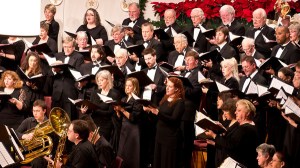
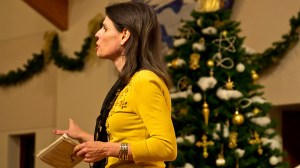
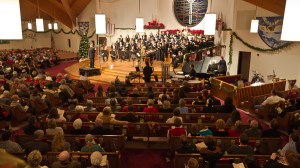
A couple of Saturday’s ago, I seized the opportunity to attend Texas Choral Consort’s traditional Christmas performance. This year’s event was called “The Sounding Joy.”  KMFA’s own Dianne Donovan introduced the event, and many KMFA friends were in the audience.

For me, the TCC Christmas concert marks the first day of the Christmas season! And this year, two of my KMFA colleagues had enrolled in this year’s performance, which included an array of festive seasonal offerings: Rutter’s Gloria, Pinkham’s Christmas Cantata, and On this Day, a Christmas Cantata by U.T. composer Donald Grantham (who was actually in the audience!). They were accompanied by some of Austin’s finest brass players as well.

I confess, I am so sentimental about the sing-along offerings that I enjoyed them the most….and whomever I was sitting next to was really a good alto.  🙂 The organ music was a delightful accompaniment,  offering just a bit more timbre than would have occurred with a piano, and at a very modest volume, so as to showcase the singers’ voices.

Thanks go out to TCC fan, Robert Kelly, who provided me with these excellent photos… click on any of the photos if you’d like to view more at his online gallery.

I am already looking forward to next year’s event!

~posted by Alison @ KMFA 🙂

Concert Chorale in the Bates Concert Hall

~posted by Carmel O’Donovan, KMFA announcer

Those who know me well (and those unfortunate enough to sit near me in church) know that I “cannot sing for toffee.” That said, I love to sing, and try not to let this minor disadvantage deter me.

By some strange quirk of fate, two of my children are extremely talented in the vocal department. Back in the UK, I fear that their talent in this area would have “fallen by the wayside” since the concept of choral singing in state-funded schools is virtually non-existent, and in the face of that, it takes real personal commitment from a very early age to develop singing skills. I seriously doubt that either of them would have persisted in their singing. Fast forward four years, and I have two children in the choir program in the Eanes School District.

Sunday, November 7th, was a “first” for me on a number of levels. It was my first visit to the Bates Recital Hall on the UT campus – what an extraordinary facility that is! It was also the first time that I had seen and heard the Visser-Rowland tracker organ. The organ was installed in 1983 and is a musical and engineering feat. With over 5000 pipes ranging from 16 feet to pencil size, the construction occupied staff for 16,750 working hours.

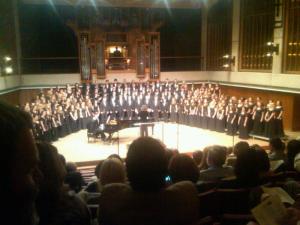
It was also a first for the Westlake High School Chorale. Under the brilliant directorship of Ed Snouffer and Jen Goodner (accompanied by the wonderfully talented Meg Houghton) they joined forces with the University of Texas Concert Chorale, directed by Suzanne Pence and Aaron Hufty, accompanied by Christopher Evatt. The combination was simply electrifying. The Westlake Chorale, numbering over 130 singers, sang four wonderful pieces, my favorite of which was “Sure on this Shining Night,” by Morten Lauridsen.
We then enjoyed a mixture of pieces from the UT choir including Gypsy songs by Brahms, Renaissance-based madrigals by Lauridsen, and a foot stomping piece by Moses Hogan. The two choirs then came together for the finale: Gloria (Movement 111) by John Rutter, and the air was filled with the magical amalgam of beautiful voices accompanied by the wonderful organ, in place of the brass for which the piece was written. Incredibly the two choirs came together for about an hour’s rehearsal prior to the performance; a measure of their combined talents and the skill and discipline of their directors. It was wonderful!

The great news is that, while this was a first, it most certainly will not be the last time that these choirs come together. I eagerly await their next concert!


~Carmel O’Donovan is a part-time announcer on KMFA 89.5; you can read more about Carmel and all our Music Hosts on our website.

Verdi’s La Traviata bears the test of time

~posted by Renee Beale, KMFA announcer… Renee was fortunate to have attended the ALO season premiere of La Traviata

“‘La Traviata last night a failure. My fault or the singers?’ Time will tell.” This has become Giuseppe Verdi’s most famous letter written about the opening night of his opera in 1853, when the performance was not met with success.

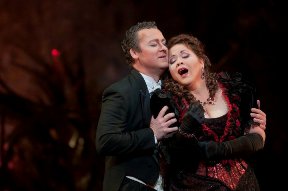
His written words convey his faith in the public’s awareness of what is good art and what is not. Opera audiences since then have proven that Verdi produced good art, and its popularity perseveres today. La Traviata has become one of the most performed operas in North America, and it doesn’t matter how many times I see it, I cry every time during Act II when Giorgio Germont requests Violetta to leave the younger Germont, because she is sullying their good name. The performances in Act II by Pamela Armstrong and Grant Youngblood were exceptional, not only in their singing performances, but in the connection they made with each other as actors. Ms. Armstrong’s accurate emotional portrayal of love mixed with shame, and acceptance of knowing the consequences of her choices would ruin her chance at true love, were captivating.

photo: courtesy of ALO's Facebook page! 🙂

While driving to ALO’s season premiere of this beloved opera, I was pleased to catch the on-air conversation that KMFA hosts Dianne Donovan and Jeffrey Blair had with Kevin Patterson, the General Director of the Austin Lyric Opera. Kevin mentioned quite emphatically that opera, and particularly La Traviata, have never been more relevant due to the social implications during that era that continue to exist today. I am always amazed how societies resist change, especially when it comes to whom one marries and whether that coupling will enhance social status (or dilute it). All the performances along with the stage design were extraordinar, and the emotionally charged connections between the actors were strong and believable. “Let’s drink to that sweet ecstasy” that is La Traviata. Bravo to ALO!


~posted by Renee Beale, KMFA announcer. You can read more about KMFA’s on-air hosts by visiting our website.